
|


The incredible story of the gas storage levyThe German market area manager Trading Hub Europe (THE) has been collecting the gas storage levy from balancing group managers since 1 October 2022 on the basis of Section 35e of the German Energy Industry Act and the methodology approved by the Federal Network Agency for structuring the gas storage levy, whereby exports from Germany are also included in the levy. The amount of the levy is adjusted every six months and initially amounted to EUR 0.59/MWh from 1 October 2022 and was subsequently increased significantly in each case: EUR 1.45/MWh from 1 July 2023 and EUR 1.89/MWh from 1 January 2024. A further increase to EUR 2.50/MWh was recently announced for 1 July 2024. The background to levying the gas storage levy is the measures taken by THE to increase security of supply in Germany, in particular the filling of gas storage facilities in Germany. The gas storage levy is significantly influenced by purchases and sales of storage volumes by THE. As prices fell sharply again in the winter of 2023/2024, THE's income from the sale of gas volumes in storage was significantly lower. However, this was not the only reason why the amount of the gas storage levy had to be repeatedly adjusted upwards; THE's levy account still has a shortfall of around EUR 6.5 billion. The decline in end consumption in Germany and in particular the transit volume through Germany also plays a role here. As exports from Germany have become economically unattractive since the introduction of the gas storage levy, gas transports through Germany have plummeted: 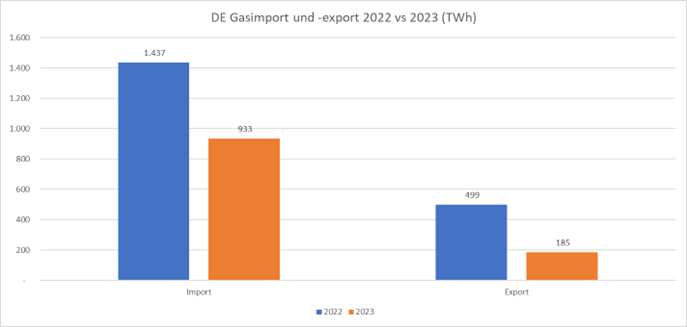 Source: Bundesnetzagentur, Illustration AGGM This development not only meant that the gas storage levy had to be increased in line with the THE calculation system. The lower injections and withdrawals in the German transmission system have reduced the tariff revenues of the German transmission system operators. Accordingly, the uniform standard fee in the German gas transmission system will increase by 31.5% from 1 January 2025 - from EUR 5.10 (kWh/h)/a to EUR 6.71/(kWh/h)/a. Booking capacity at LNG terminals for the target market outside Germany, which are being built at record speed in Germany, is also unattractive against this backdrop. Whether these effects, which ultimately also significantly increase the costs for end customers in Germany, were intended? In any case, a win-win situation was not created by charging the gas storage levy at cross-border delivery points. AGGM has voiced its legal concerns and pointed out the negative effects since the introduction of charging the gas storage levy at cross-border delivery points. The diversification of gas supplies and independence from Russian natural gas that the European Union is striving for is significantly hindered by the significant increase in the cost of transport from Germany for landlocked countries such as Austria. Union law stipulates that national measures to increase security of supply must not have a negative impact on neighbouring Member States or cross-border transports. It is precisely this principle that is violated by the levying of the gas storage levy on cross-border gas transports. The levying of import and export duties and charges with equivalent effect between Member States, including so-called parafiscal charges, violates Union law. Both apply to the gas storage levy. As clear as the legal situation is, the possibilities for enforcing the law are unfortunately complex. AGGM and other Austrian companies have filed complaints with the European Commission to assert the unlawfulness of the levy, AGGM has also filed applications with the Federal Network Agency and complaints with the Düsseldorf Higher Regional Court, which have not yet been finally decided. As a result, the discussion about the gas storage levy at a political level was slow to get underway - also with the support of the regulators. However, neither the member states nor the European Commission were able to bring themselves to initiate infringement proceedings against Germany. Instead, a compromise was found, according to which Germany will stop charging the gas storage levy for exports from 1 January 2025, in return for which it is likely that political negotiations have agreed to refrain from any further assertion of illegality for the period since 1 October 2022. Even if the abolition of the gas storage levy from 2025 is to be welcomed - the corresponding draft law has now been passed by the German Federal Cabinet and is in the parliamentary process - an extremely sour aftertaste remains. |
|