
|


Why we need to think about the hydrogen ramp-up in steps – and why this is important now."Hydrogen is the champagne of the energy transition." Many will still remember this phrase whenever the topic comes up. But that narrative is gradually fading, as it becomes increasingly clear: the energy transition cannot succeed without renewable gases, especially hydrogen. In fact, hydrogen is set to become the centerpiece of the energy transition. The recently published Second Austrian Assessment Report on Climate Change also confirms the urgent need for action: even by 2040, despite electrification and comprehensive efficiency measures, there will still be a demand for CO₂-neutral gases. To successfully integrate renewable hydrogen into the energy system, we need suitable, high-performance infrastructure that delivers hydrogen where it's needed and collects it from where it can be produced. Austria now stands at a crucial crossroads: We have a favorable geographical position, we have the know-how, and we have a well-developed existing gas infrastructure. And we have something even more important: a concept for how this transformation can succeed – our H₂ Roadmap 2.0, which outlines the development of a hydrogen network. By repurposing approximately 1,400 km of existing gas pipelines, the gas grid will be resized, and the foundation for a hydrogen transport network will be created – which will then be completed by adding around 700 km of new hydrogen pipelines. All details can be found here. What’s still missing? The necessary political decisions for the next steps. Of course, implementing the legal framework is complex – but if we don’t act quickly (this year!), we risk falling behind European developments. That would mean losing relevance in the European Hydrogen Backbone – at the expense of supply security and cost efficiency. But where do we begin? This is the key point: Anyone planning for hydrogen must distinguish clearly between the initial hydrogen grid today and the core hydrogen network of tomorrow. This is not just semantics – it’s the key to a functional, fair, and future-proof system. Why? The initial network is the runway – the launch infrastructure. It forms part of Europe’s major hydrogen highways and connects them with Austria’s storage facilities and the first regional hydrogen clusters. This needs to happen NOW, or we’ll miss the train and forfeit our role as a hydrogen transit country. In contrast, the core network is more flexible – it grows with the market, with demand, with the pace of industrial development. For that, we need a dynamic, long-term concept. Not a rigid list. Not a fixed blueprint. But a responsive mechanism that kicks in when demand arises and still offers reliability. That’s why we now need a swift decision on the regulatory framework, and Governmental support or guarantees. Why is state financing even necessary? Hydrogen is a central pillar of the energy transition. But: current demand isn’t (yet) high enough to finance the infrastructure through user fees alone. In the early stages, there simply aren’t enough "grid users" – that is, producers and consumers – regularly paying for transport. Without public support, network expansion either wouldn’t happen at all, or would be limited to a few already profitable regional projects. That would leave out many regions and businesses – and severely slow down the growth of a hydrogen economy. That’s why we propose a sequential approach: Act immediately, while also planning strategically. A concept that mitigates risk, enables investment, and avoids misallocation. 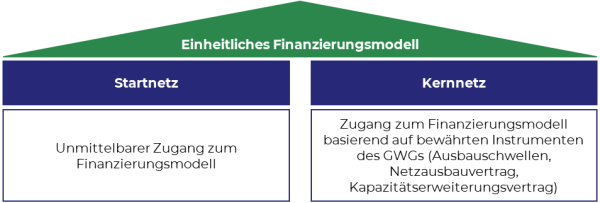 The key: one unified financing model that covers both the initial and core networks – ensuring no region or company is left behind. No discrimination, no imbalance – just clear, equal rules for all. The core principle: intertemporal cost shifting A central financing lever is the principle of intertemporal cost shifting. That may sound technical – but in essence, it means: The state advances part of the network expansion costs – and recovers them later, once enough users are connected and paying tariffs to sustain the system. This prevents early users from bearing excessive costs – and ensures the state recoups its investment over time. |
|