
|


A CO₂ collection and transport network for AustriaInitial facts and figures Austria has committed to achieving climate neutrality by 2040. The remaining hard-to-abate CO₂ emissions, as well as biogenic CO₂ emissions from large individual sources in industry and the energy sector, must therefore be captured and transported to users such as the chemical industry for further use (utilisation) and/or storage. This requires a new pipeline system. The responsible Ministry for Climate Protection, Environment, Energy, Mobility, Innovation and Technology (BMK) has commissioned a consortium consisting of AIT-Austrian Institute of Technology, Frontier Economics, Montanuniversität Leoben and AGGM to carry out a feasibility study for this infrastructure. Here is a brief outline of the results:
A CO₂ network for Austria is feasible but is associated with high capital and operating costs. There is currently no regulatory framework for the transport of CO₂. However, it can be deduced from the study that a CO₂ collection and transport network in Austria is necessary in order to secure the business location in the long term and to achieve climate neutrality in a targeted manner. Only with a CO₂ transport network can individual branches of industry be decarbonised and biogenic CO₂ can be removed from the atmosphere via biomass. 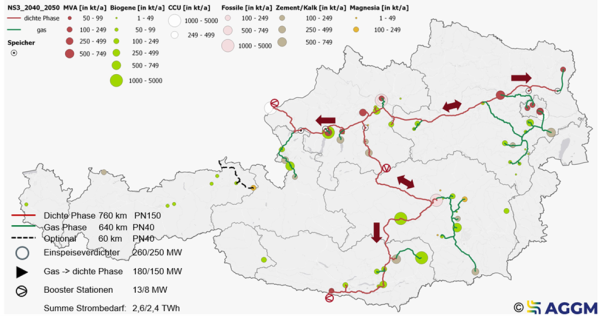 |
|